

30 years of the BMW M3 – the story behind the legend.
2016 marks the 30th anniversary of a motoring icon, one which revolutionised the mid-size sports car segment when its production started in 1986. The very first BMW M3 set a new standard by which other carmakers would be measured – and, five model generations later, are still judged today. BMW Motorsport Division, the precursor to BMW M Division, was incredibly rigorous in its deployment of undiluted motor racing technology in the development of the first-generation BMW M3. Its endeavours produced a thoroughbred high-performance sports car – based on the series-produced BMW 3 Series – that was perfectly suited to daily use. Over the three decades that have followed, BMW M has gently refined its trailblazing and highly successful creation from one generation to the next, while always taking great care to preserve the original character of the M3. The upshot is that there is arguably still no other car that blends such prominently honed motor sport genes and uncompromised everyday practicality into such an emotionally stirring overall package.
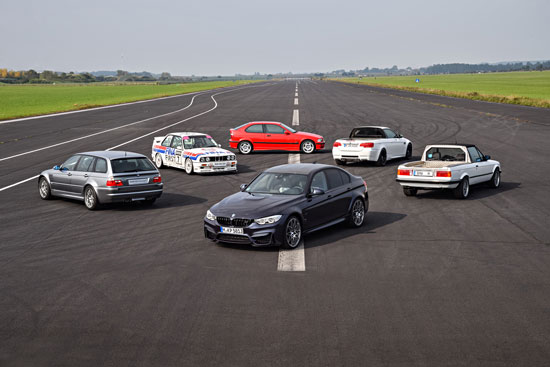
The 30th anniversary of the BMW M3 provides an ideal opportunity to look back at four highly intriguing model variants that, for various reasons, never made it past the prototype stage. Four surprise guests will therefore be attending their progenitor’s birthday party: the BMW M3 Pickup from 1986, the BMW M3 Compact from 1996, the BMW M3 Touring from 2000 and the second incarnation of the BMW M3 Pickup unveiled in 2011.
Use in touring car racing was the overriding development objective for the first-generation BMW M3.
The BMW M3 was not an attempt to produce a sporting flagship for a volume-produced model range; instead it originated from the idea of developing a racing car for motor sport that would also be available in a road-going version. The selected category of racing was Group A production touring cars – as seen in the German Touring Car Championship (DTM) that had succeeded the German Racing Championship (DRM). The Group A regulations stated that for a racing car to be homologated, at least 5,000 road-legal units had to be sold within 12 months.
Having the chance to develop the production and race versions of the car alongside one another presented the development team with a tremendous opportunity, which they duly capitalised on. The axle kinematics, suspension and damping were all perfectly tailored to the future demands of motor racing, as was the braking system, which combined the standard ABS with inner-vented brake discs at the front and an engine-driven high-pressure pump. Details such as the transmission’s shift pattern with first gear at the bottom left also gave a clear indication of the vehicle’s singular focus on racing.
On top of this came extensive weight-saving measures. While the body with broad wheel arches was manufactured from sheet metal in the traditional manner, the front and rear bumpers along with the side skirts, boot lid and spoiler were made of plastic, reflecting the engineers’ commitment to intelligent lightweight construction. The BMW Motorsport experts tweaked the car’s aerodynamics too, with the C-pillar of the BMW M3 following a slightly shallower angle than the standard body and having a broader base. This allowed the airflow to be directed towards the distinctive rear spoiler more effectively.
Extensive use of high tech in the powertrain, too.
The experts at the Motorsport department used the two-litre four-cylinder engine fitted in series-production models as the basis for the M3’s unit, as the low weight of its construction and its high-revving capabilities meant it had exactly the right ingredients for a racing engine. To transform the well-mannered everyday engine into an athletic performer with sports car credentials, however, they had to subject it to some intensive power therapy.
First, they increased its displacement to 2.3 litres and converted it to a four-valve arrangement. For this purpose, the team employed a suitably modified cylinder head taken from the six-cylinder engine featured in the BMW M1, whose combustion chambers were – conveniently enough – spaced exactly the same distance apart as the four-cylinder unit’s. The crank drive on the BMW M3 was designed to be so rigid that it could handle 10,000 revolutions per minute and more. The standard production car’s rated engine speed of 6,750 rpm therefore left plenty of margin for further evolutions of the motor sport off-shoot.
From sporting machine to heavy-duty transporter: the BMW M3 Pickup (1986).
When the first generation of the BMW M3 was brought out, it wasn’t just customers who were enthralled by its exceptional dynamic abilities. It also caused quite a stir within the BMW Motorsport department responsible for its development, who saw it as the perfect means of transporting work equipment and parts around the premises of what is now BMW M Division in Garching near Munich. The only problem was that goods transport didn’t figure very highly on the list of the first BMW M3’s many talents.
It didn’t take long to remedy the situation, the body of a BMW 3 Series Convertible being transformed into a BMW M3 Pickup. “The convertible bodyshell was chosen as the basis for two reasons,” recalls Jakob Polschak, head of vehicle prototype building and workshops at BMW M Division and an employee at the company for more than 40 years. “Firstly, we happened to have such a model at our disposal and in perfect condition. And secondly, the convertible’s built-in bracing made it the ideal choice for a pickup conversion.”
The first BMW M3 Pickup did not sport the original’s boldly flared wings, as it was equipped with the narrower body of its regular, volume-produced sibling. At first it was powered by the engine fitted in the so-called “Italian M3”, which had a reduced two-litre displacement due to tax regulations there and an output of 192 hp. “Later we switched to the original 2.3-litre four-cylinder engine with 200 horsepower,” reveals Polschak. The BMW M3 Pickup went about its work around the factory premises reliably for over 26 years before finally being retired four years ago.
The BMW M3 Pickup’s long service life alone is clear evidence that the one-off versions being presented here are not mere gimmicks or engineering exercises. On the contrary, they are high-performance cars that have been optimised to perfectly match their intended task or field of use. As such, they epitomise the philosophy of BMW M. Plus, they also fulfilled another important purpose: “Our apprentices, graduate trainees and placement students assisted in the construction of all of these prototypes,” explains Polschak. “This allowed them to gain invaluable hands-on experience at the same time as freeing up resources for us – a classic win-win situation.”
A starter model for young target groups: the BMW M3 Compact (1996).
The same was also true of the 1996 BMW M3 Compact, of course. The idea behind this model was to present younger customers, in particular, with an entry point into the world of BMW M cars. “To a certain extent, the M3 Compact can be regarded as the forefather of today’s BMW M2,” remarks the BMW M workshop chief with a twinkle in the eye, and it’s easy to see why he draws the comparison. If it had gone into production, the M3 engine’s power would in all likelihood have been lowered somewhat. In the prototype, however, it was allowed to unleash its full 321 hp, which made easy work of propelling a lightweight car (it tipped the scales at just 1.3 tonnes). “It is 150 kilograms lighter, more agile, firmer and even more uncompromising,” enthused German motoring magazine “auto motor und sport” (issue no. 13/1996) after testing it.
A feasibility study under real-world conditions: the BMW M3 Touring (2000).
The BMW M3 Touring prototype likewise materialised because a production model was under consideration. The M3 Compact was made available to journalists for testing in order to both project an image and sound out customer interest. But the M3 Touring served entirely in-house purposes. “This prototype allowed us to show that, from a purely technical standpoint at least, it was possible to integrate an M3 Touring into the ongoing production of the standard BMW 3 Series Touring with very little difficulty,” explains Jakob Polschak. “One important thing we needed to demonstrate was that the rear doors of the standard production model could be reworked to adapt them to the rear wheel arches without the need for new and expensive tools.” Once it had passed through the assembly line, the M3 Touring required only minimal manual follow-up work to fit the M-specific add-on parts and interior details, for example.
History repeats itself: the BMW M3 Pickup (2011).
Once the first-generation BMW M3 Pickup described above eventually started to show the first serious signs of wear after around a quarter of a century of service, it was time for a successor. As with the original, those responsible for its creation again opted for a convertible body due to the existing strengthening elements. “The conversion work had initially proceeded in the usual, largely unspectacular manner during the spring of 2011. But then someone came up with the idea of marketing the vehicle as an April Fools’ joke, as April 1 was just around the corner,” recounts Polschak. To prime the public, spy shots of calibration runs on the Nürburgring’s Nordschleife circuit emerged in the run-up to the day, which served to fuel speculation about plans to build a production model.
And it worked. Reports from the time show that a good many journalists and bloggers took the bait and believed the rumours. Even the official press release published on 1 April 2011 did not immediately set matters straight, first presenting the BMW M3 Pickup as the “fourth body variant” following the Sedan, Coupe and Convertible, before going on to say: “309 kW/420 hp under the bonnet and a payload capacity of 450 kilograms over the rear axle take the BMW M models’ hallmark blend of racing-style driving pleasure and everyday practicality to a whole new level.” It also pointed out that the Cd was only marginally higher than that of the BMW M3 Coupe, the car was 50 kilograms lighter than the Convertible and the 20-kilogram targa roof could be removed to further lower the centre of gravity and therefore deliver even sharper handling dynamics.
It wasn’t until the final paragraph that the press release discreetly revealed the model in question was actually a one-off built for use as a workshop transport vehicle. Unlike its predecessor, however, it had also been licensed for road use.
The BMW M3: a sporting icon and dynamic benchmark for five generations.
30 years ago almost to the day production began of the first series-produced BMW M3s. This represented the opening chapter in a story of success which has no equal in the automotive world. The 2.3-litre four-cylinder unit with four-valve technology produced 147 kW/200 hp and accelerated the M3, which weighed just 1,200 kilograms, from 0 to 100 km/h (62 mph) in just 6.7 seconds. Top speed was 235 km/h (146 mph). In 1988 the Evo version was unveiled, with power increased once again to 220 hp and its top speed to 243 km/h (151 mph). And this was followed in 1990 by the final development stage of the first-generation M3: the BMW M3 Sport Evolution with 238 hp 2.5-litre engine, produced in a limited run of 600 examples.
The second generation of the BMW M3 – not developed specifically for use in motor sport this time – was a much more understated affair. Unveiled in 1992, its six-cylinder engine developed 210 kW/286 hp from three-litre displacement and peak torque of 320 Newton metres (236 lb-ft). It also featured the innovative new camshaft control system VANOS. The new model set two world records – for the highest output per litre (97 hp/l) and the highest specific torque (108 Nm (80 lb-ft)/l) produced by a volume-produced naturally-aspirated engine.
An extensive facelift in 1995 saw the displacement of the six-cylinder in-line engine increased from 2,990 to 3,201cc, with output rising to 236 kW/321 hp. Added to which, the new engine also employed Double-VANOS, which brings fully variable camshaft control on both the intake and exhaust sides. In summer 1996 the BMW M3 became the first series-produced car to be offered with the option of an SMG automated manual gearbox.
Featuring an aluminium bonnet with powerdome, prominently flared wheel arches, an aerodynamically optimised boot lid with rear spoiler lip and four tailpipes exiting the dual-flow exhaust system, the third-generation BMW M3 unveiled in 2000 cut an extremely eye-catching figure once more. Power again came courtesy of a naturally-aspirated six-cylinder in-line engine. The completely newly developed unit developed output of 252 kW/343 hp from its 3,246 cc and peak torque of 365 Newton metres (269 lb-ft).
Instead of being equipped with a straight-six engine, like the two previous generations of the car, the fourth incarnation of the BMW M3 presented in 2007 was powered by a high-revving, naturally-aspirated V8 developing 309 kW/420 hp. Among the extensive intelligent lightweight design measures employed were the carbon fibre-reinforced plastic (CFRP) roof fitted as standard and a front axle made almost entirely from aluminium.
The current (fifth) generation of the BMW M3 was introduced in spring 2014. In keeping with the change in nomenclature for BMW’s series-produced models, only the four-door sedan is badged “M3”, while the coupe and the convertible variants were given the model designation M4. In all three body variants, a free-revving straight-six engine with M TwinPower Turbo technology and 317 kW/431 hp provides the power. Rigorously applied intelligent lightweight design elements include the extensive use of lightweight materials such as CFRP and aluminium for many chassis and body components. All of which has shaved around 80 kilograms off the weight of its predecessor.
This summer, BMW M Division released an exclusive special-edition model – limited to 500 units worldwide – as a special tribute to the successful 30-year history of the BMW M3. With its Macao Blue metallic exterior paint finish, the BMW M3 “30 Jahre M3” harks back to the first generation of car, for which this colour shade was first offered. The Competition Package, which is included as standard and comprises extensive powertrain and suspension modifications, pushes the engine output of the anniversary model up by 14 kW/19 hp to 331 kW/450 hp.